














News & Media

Stay up to date with the latest news, insights, and industry collaborations from the world of KenWave—where innovation meets pipeline assessment.

Extending the Life of a 93-Year-Old Water Main: Lessons from Baltimore

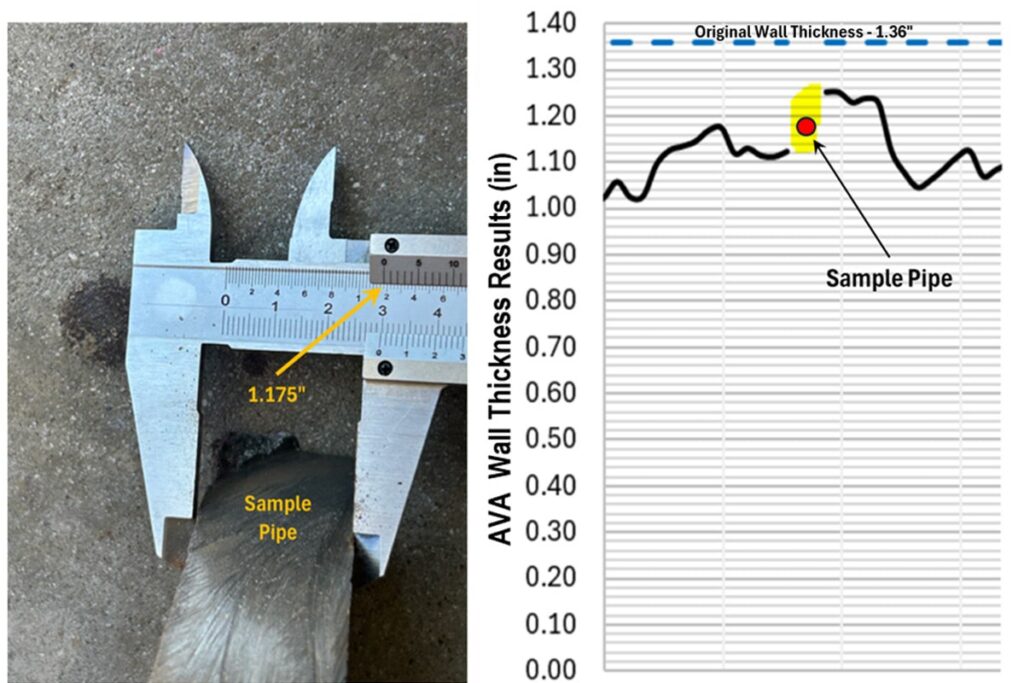
Image courtesy of RJN / Trenchless Technology

Across North America, utilities are confronting the same reality: critical transmission mains installed in the early 20th century are approaching or exceeding their nominal design life. The question facing asset managers is no longer whether these assets are aging, but whether replacement is always necessary.

A recent feature in Trenchless Technology highlights how RJN Group Inc. supported the City of Baltimore in extending the service life of a 93-year-old water main using advanced acoustic condition assessment. RJN’s method, known as AVA, is a licensed deployment of KenWave’s Dynamic Response Imaging (DRI) technology.

The project provides a powerful example of how non-destructive condition assessment can shift infrastructure decisions from assumption-based replacement to data-driven lifecycle management.

The Challenge of Aging Transmission Infrastructure

Large-diameter metallic and concrete cylinder water mains installed in the 1920s and 1930s were engineered to serve growing cities for generations. Many of these assets remain in operation today, forming the backbone of municipal water transmission systems.

However, utilities face significant uncertainty:

  • Has wall deterioration reached a critical threshold?
  • Is localized pitting progressing toward failure?
  • Does the pipe require full replacement, sectional rehabilitation, or continued monitoring?

Without direct wall condition data, utilities often rely on age, break history, or surrogate indicators to inform capital planning. This can lead to premature replacement, emergency failures, or misallocated capital budgets.

Baltimore’s situation reflects a broader North American trend. Transmission mains are aging, but replacement costs are escalating. Municipalities must balance risk, reliability, and long-term affordability.

A Non-Destructive Alternative to Excavation

In the Baltimore case, RJN deployed AVA, a licensed implementation of KenWave’s Dynamic Response Imaging technology.

DRI works by introducing controlled vibration signals into the pipeline at predefined access points. These signals are tuned to interact with the pipe material and geometry. The acoustic response is captured and analyzed to infer wall condition, localized deterioration, and structural integrity, without excavation or service interruption.

This approach enables utilities to:

  • Assess remaining wall thickness
  • Identify areas of accelerated deterioration
  • Prioritize localized intervention
  • Defer unnecessary replacement

Instead of relying on assumptions tied to age alone, decision-makers gain quantitative insight into actual structural condition.

Moving from Age-Based to Condition-Based Decisions

The Baltimore project illustrates an important shift in infrastructure strategy.

Historically, aging mains often triggered blanket replacement programs. While conservative, this strategy can consume capital that might otherwise address higher-risk assets elsewhere in the system.

By leveraging advanced acoustic condition assessment, utilities can:

  • Validate structural capacity
  • Quantify remaining service life
  • Identify segments requiring targeted rehabilitation
  • Extend asset life safely and strategically

In Baltimore’s case, the 93-year-old water main did not represent an immediate end-of-life condition. Instead, condition assessment provided evidence to support informed, risk-based planning.

For asset managers operating under constrained capital budgets, this is not simply a technical advantage. It is a financial and governance imperative.

Implications for Utilities Across North America

Baltimore is not unique. Major metropolitan areas across the United States and Canada operate transmission mains approaching a century in service.

The implications are significant:

  • Replacement of large-diameter transmission mains can cost tens of millions of dollars per segment.
  • Emergency failures can disrupt communities and damage public trust.
  • Blanket replacement strategies are rarely aligned with optimal capital allocation.

Condition assessment technologies such as DRI, deployed directly or through licensed partners such as RJN, allow utilities to transition toward evidence-based asset management.

This approach aligns with modern risk frameworks, asset management standards, and long-term financial sustainability objectives.

Independent Validation in a Leading Industry Publication

The feature in Trenchless Technology provides independent industry recognition of this approach in action. As a leading trade publication serving the underground infrastructure sector, coverage in Trenchless Technology reinforces the technical credibility of advanced condition assessment methodologies.

For KenWave, the Baltimore deployment demonstrates the real-world impact of licensed DRI implementations in complex urban environments. For utilities evaluating their own aging infrastructure portfolios, it offers a practical example of how data-driven insight can replace uncertainty.

Learn More

The full project story, including details on the Baltimore deployment, can be read in the original Trenchless Technology article:

City of Baltimore Extends the Life of a 93-Year-Old Water Main
https://trenchlesstechnology.com/city-of-baltimore-extends-the-life-of-a-93-year-old-water-main/

If your utility is evaluating aging transmission mains and seeking a non-destructive, evidence-based approach to lifecycle extension, KenWave’s Dynamic Response Imaging technology can provide the structural insight required to inform responsible capital planning.

Aging does not automatically mean replacement. With accurate condition data, it can mean strategic extension.

Why Utilities Are Turning to Dynamic Response Imaging™?

  • Non-invasive, external platform

  • 🔧 Works through valves, hydrants, and access points

  • 🛰️ Detects wall thinning, pipe class changes, leaks
  • 📏 5–20 ft sub-pipe stick resolution
  • 🧠 Ideal for sub-transmission and hard-to-inspect pipes

  • 📊 Supports capital planning with real-world data

Partnered with Leading Utilities & Consultants Globally

More News

OWWA NextWave 2026 Conference

KenWave will be at OWWA NextWave 2026 in Niagara Falls (May 4–7), exhibiting at Booth #701 and presenting with Peel Region on how vibroacoustic inspection data supports risk-based watermain renewal planning.

Read More »

Extending the Life of a 93-Year-Old Water Main: Lessons from Baltimore

A Trenchless Technology feature highlights how RJN deployed a licensed implementation of KenWave’s Dynamic Response Imaging (DRI) solution to assess and extend the life of a 93-year-old Baltimore water main. The project demonstrates how non-destructive condition assessment enables evidence-based lifecycle decisions for aging transmission infrastructure.
Read More »